

Designing something tangible
So that more products go the way of the typewriter
A few people have said to me, “I think you are up to something interesting with AGE & Grace, BUT I don’t quite get it yet.” Okay. Feedback heard and appreciated.
So let’s try talking about how I’ve designed it. Maybe that will help.
People who know me know that I use visual design to create environments. Strong visual structure enhances our positive impression – actually helps people relax into topics and even challenging conversations. It sets the tone in support of goals. Whether facilitating, preparing strategy roll-outs, my own personal way of speaking, our office – even my home – it is meant to support a style of interaction. Energy with openness.
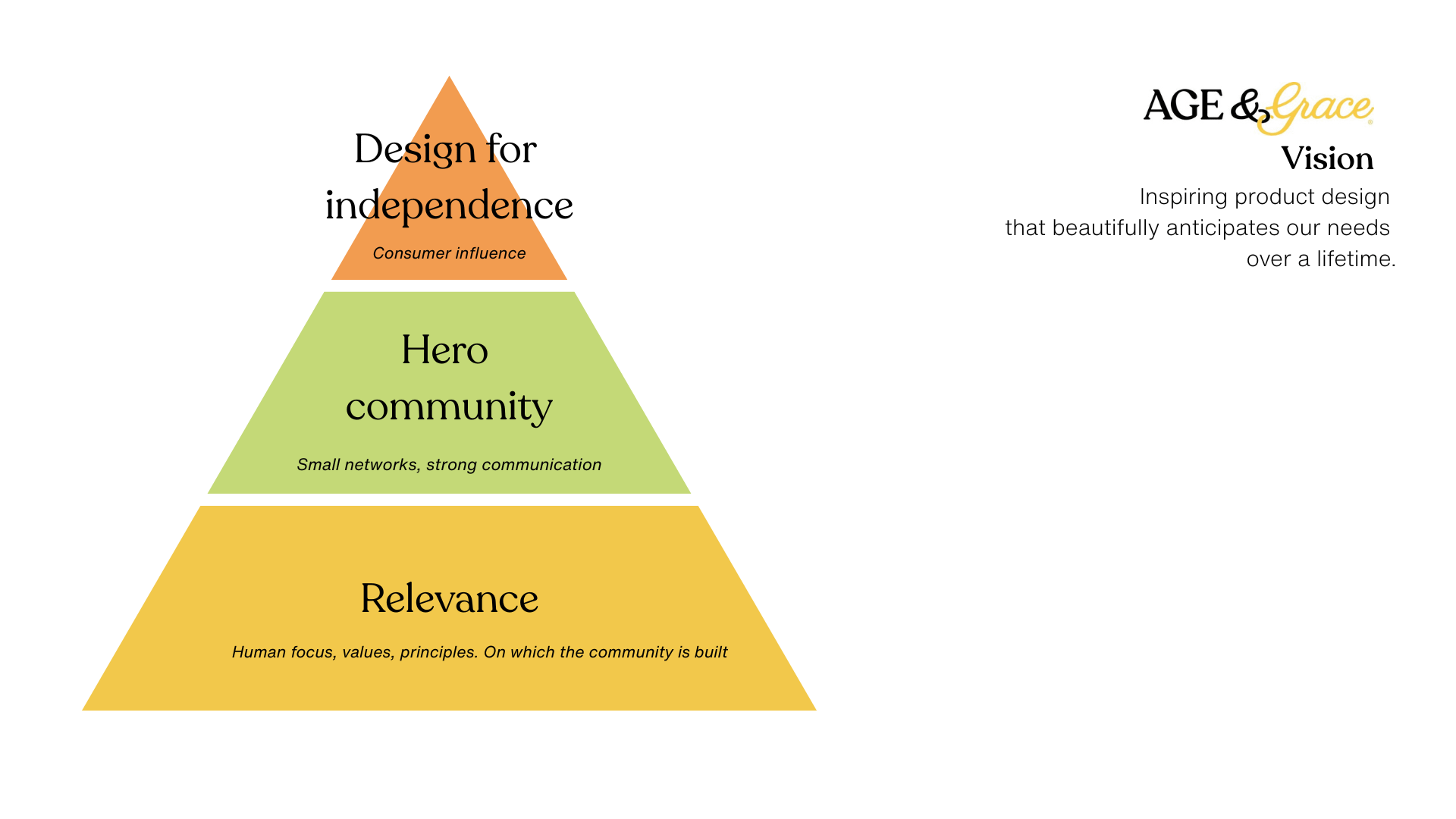
I invested some time on the design that supports AGE & Grace. Finally decided on three levels that lead from community principles to the flagship interaction and ultimately the result of having better product and service design. It goes like this:
Relevance. Our foundation. The human value on which AGE & Grace is built. I read a lot of research on aging over the last years. Not always uplifting when you peek around that later life corner. What I learned and want people (you!) to consider: make conscious, proactive steps for staying engaged in your whole life, including after whatever is your “designated retirement age.” If you fully retire at all. I don’t mean financial and health (these topics are well covered). I mean asking yourself to meet the challenge of cultivating your sense of purpose and setting an aligned structure to support it. Especially growing your continued curiosity, the desire to know what trends are shaping the world in which you (still!) live. To thereby feel and actually be “cool.” It is this shared human challenge at the base of our work on which we will design our interactions. Respect for the deep down desire to matter and to be seen as a person across a lifetime.
Your Hero Community. A new conversation. Hero Community communication comes also from my last five years as CEO of a wearable safety alarm company – during which I saw the many ways that people benefit from connection when they need help. I want each of us to find three or four people with whom we are willing to discuss together “being each other’s heroes” – in what circumstances we might need help, how someone would notice it. What “help” means to us and what is not helpful.
Asking for help becomes more off-putting as we get older because it makes us feel vulnerable. Even when we recognize that we are more vulnerable, we still want to be known as our stronger original selves. We won’t rush to wear or accept most things that make us feel less a person. Open, honest acknowledgement of this human dilemma can actually prove moving, uplifting, and meaningful, as well as pragmatically valuable. It can be light and with some humor about our shared humanity. We often discussed it with my previous team members. I wish everyone would do it.And finally Design for Independence. This is actually the vision at the tip of the iceberg that needs the other two levels of underpinning. For me, there are a few obvious first great options to show what beautiful design could do differently to change the “stamped as old” mentality and help us stay autonomous. I believe a wider community of like-minded people would find more. My goal is to drive change, not to sell the products. Best-in-class suppliers can do the selling. First, we need better design.
Let’s take (again) my current favorite example of “grab bars.” I’ve heard feedback that this example is unrelatable for younger people. If you are designing your place in your 30s, you will anyway likely move to a different home later. And the image we have in our minds when someone says “grab bar” is confronting visually and emotionally, negative. True. Fair enough. Yet this is exactly my point: I want total new design thinking about how we consider beauty, comfort and safety in our bathrooms. In my vision, the words “grab bar” completely disappear from use. Or are heard only in reference to the old days like “do you remember typewriters” (okay people fondly keep their vintage typewriters that have beautiful design – good luck with any of us keeping vintage grab bars! 😊). With all of us wanting to live longer and healthier, why is it so difficult to envision a redesign that is beautiful and simply expected?? WHY? Have we lost our imaginations (e.g. you home architects out there who give me one million and one excuses)? How can we make beautiful, comfortable and safer design a cash cow for the players and accessible to all of us. HOW. In the next month, I’m going to give at least one example. And I want you to weigh-in on how you see it.
So, what’s next tangibly? I’ve started getting out the messages here since July. Now I’m going to put together some “designed interaction” seminars for the first two levels (a la our Modern Careers: What’s Your Strategy?” program that was popular, although I didn’t scale it at the time). This time, I will take these modules anywhere I can get people to try them - especially for near-retirement ages (i.e. 55-60ish). Even if you don’t have interest in the product design, these topics will add perspective for living a longer, healthier life. And create rewarding exchanges with others.
Then we will recruit volunteers from the participants in 1 & 2 – who have the shared conversation basis - to help accomplish 3, influencing the product and service designs of our future. We will become influencers with common cultural values. And we will have some high quality, professional interaction, even fun, doing it.
Will keep you updated! I hope that you will find AGE & Grace valuable and thought-provoking.
Thank you for reading.
That’s so helpful Jill! I do have a classic Olivetti typewriter in my basement :) However the grab bar example grabbed me - a perfect example. Thank you. Look forward to what’s ahead.